




Event Organised by Centre for Research in Rural and Industrial Development (CRRID), Sector 19, Chandigarh
Event Supported by Indian Farmers Fertilizer Cooperative Ltd (IFFCO), Chandigarh
Chandigarh, 12 December, Punjabi Dunia Bureau:
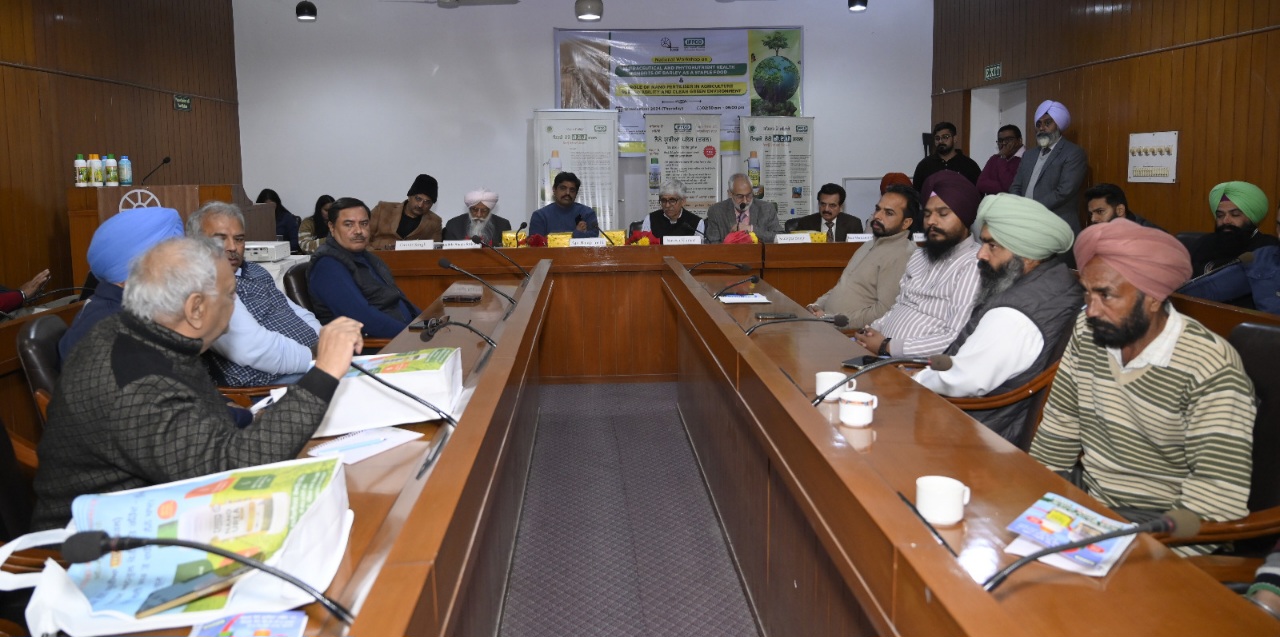
The Centre for Research in Rural and Industrial Development (CRRID), Sector 19, Chandigarh, organized a National Workshop on “Nutraceutical and Phytonutrient Health Benefits of Barley as a Staple Food” and “Role of Nano Fertiliser in Agriculture Sustainability and Clean Green Environment”.
The event was supported by the Indian Farmers Fertilizer Cooperative Ltd (IFFCO), Chandigarh. The session commenced with a warm welcome from Dr. Bindu Duggal, Director (Acting) CRRID. Dr. Ranjodh Singh Bains, (Department of Agriculture and Farmers’ Welfare, Government of Punjab), provided a brief introduction of the speakers and outlined the objectives of the workshop. He emphasized the importance of barley and nanotechnology, particularly its role in benefiting farmers and the wider community.
The Speaker for the first lecture was Prof. Dr. Omvir Singh (Principal Scientist), Barley Improvement, IIWBR, Karnal. Prof. Singh compared barley to other common cereals like wheat and rice, emphasizing on its nutrition, especially in terms of protein. He explained that barley has much less gluten compared to wheat, which contains 80% gluten which leads to serious health issues such as cancer, kidney damage, and leaky gut syndrome. Prof. Singh also highlighted the importance of gut health, calling the gut as the “second brain.”. Environmentally, barley requires less water for cultivation and is suitable for organic farming. Finally, he stressed on the need to promote consumption of whole barley and educate people about its health benefits. He concluded by encouraging to include more barley in daily diet for better health and disease prevention.
The lecture by Prof. Om Vir Singh was Chaired by Shri Ajit Balaji Joshi, IAS (Secretary Agriculture and Farmers’ Welfare, government of Punjab). In his address, Shri Joshi highlighted the Punjab government’s commitment to promoting crop diversification as a key strategy for improving agricultural sustainability. He emphasized the importance of shifting towards more diverse crops to reduce dependency on water-intensive farming practices. He also drew attention to the significant challenges faced by farmers in Punjab, particularly the growing water scarcity issue. He stressed the need for innovative solutions and sustainable agricultural practices to address these concerns and ensure the long-term viability of farming in the state.
The second lecture on topic “Role of Nano Fertiliser in Agriculture Sustainability and Clean Green Environment” delivered by Shri Harmail Singh Sidhu (State Marketing Manager, IFFCO, Punjab). Shri Sidhu highlighted that Punjab has a large irrigated area, making efficient fertilizer use essential. He also discussed the environmental problems caused by the overuse of chemical fertilizers since the Green Revolution, including soil degradation and water pollution. He emphasized that nano fertilizers could help address these issues, promoting eco-friendly farming practices.
The second lecture was chaired by Prof. Sukhpal Singh, Chairman, Punjab State Farmers’ & Farm Workers’ Commission, Government of Punjab. Prof. Singh discussed the importance of crop diversification for improving farmers’ profits and also highlighted the crucial role of research institutes and the government in supporting it through innovation, education, and policy-making.
The Chief Guest of the event, Shri Suresh Kumar, IAS (Retd.), Former Chief Principal Secretary to the Chief Minister of Punjab. He highlighted the need for advanced research and technology to strengthen farming practices and ensure food security, especially in the wake of the Covid-19 pandemic. He suggested that barley could replace wheat but before that the need is to address agricultural challenges and improve farmers’ economic conditions. Shri Kumar also noted that farmers face exploitation when they are unable to negotiate with large corporations and urged for policies to enhance their income and protect their interests. He stressed that for the purpose of achieving crop diversification, there is need for risk mitigation for the famer and ensuring income enhancement. He highlighted the need for introducing laws on agriculture input service management. He concluded by stressing the importance of contextual research and policies to address the needs of farmers.
Shri Balbir Singh Rajewal, BKU (Rajewal) focused on the importance of barley in improving farmers’ livelihoods. He called for stronger government policies to address the problems faced by farmers, such as water scarcity and unsustainable farming practices.
Shri Bal Mukand Sharma, Chairman, State Food Commission, Government of Punjab, highlighted the benefits of including barley in daily food. He emphasized how barley can be a healthy addition to everyday meals. Dr. Vinod Kumar Choudhary, Chairperson of the Department of Sociology, addressed the serious issue of stubble burning, which continues to affect the environment and public health. He stressed the need for effective solutions to this growing problem. Various farmers’ unions attended the workshop, sharing their concerns about water, marketing, and stubble burning.
Apart from the dignitaries, event was attended by farmers and academicians from various universities and colleges.
